Problem other/agh/2025/1.2.tex
Zadanie 2.
Treść zadania
Naszkicuj wykres funkcji danej wzorem $$ f(x) = \lim_{n \to \infty} \left(1 + \left(\frac{x}{2}\right)^{2n} + x^n\right)^{\tfrac{1}{n}} $$ dla $x\geq0$.Rozwiązanie
Zauważmy, że $$ \left(\frac{x}{2}\right)^{2n}=\left(\frac{x^2}{4}\right)^n. $$ Czyli mamy: $$ f(x) = \lim_{n \to \infty} \left(1^n + \left(\frac{x^2}{4}\right)^n + x^n\right)^{\tfrac{1}{n}} $$ Dla dużych $n$ $n$-ty pierwiastek z sumy trzech dodatnich składników zachowuje się jak największa podstawa potęgi: $$ f(x)=\max\!\left\{1,\;x,\;\frac{x^2}{4}\right\}. $$Kiedy $x > \dfrac{x^2}{4}$? \begin{align*} x &> \frac{x^2}{4} \\ x(x - 4) &< 0 \end{align*}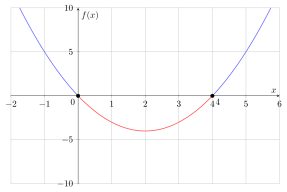
- $0 \leq x < 1$ Skoro $x < 1$ to $$ \lim_{n \to \infty} x^n = 0 $$ oraz $$ \lim_{n \to \infty} \left(\frac{x^2}{4}\right)^n = 0 $$ Zatem $f(x) = 1$.
- $x = 1$: $\frac{x^2}{4} = \frac{1}{4} < 1$. Zatem $$ f(x) = \lim_{n \to \infty} \left(1^n + 1^n\right)^{1/n} = \lim_{n \to \infty} 2^{1/n} $$ Znany fakcik: $$ 2^{1/n} = e^{\left(\ln 2\right) / n} $$ Gdy $n \to \infty$ to $\dfrac{\ln 2}{n} \to 0$ Zatem $$ f(x) = \lim_{n \to \infty} 2^{1/n} = \lim_{n \to \infty} e^{\left(\ln 2\right) / n} = e^0 = 1 $$
- $1 < x < 4$ Tutaj mamy, że $x > \frac{x^2}{4}$, czyli dominujący jest $x$. Zatem $$ f(x) = \lim_{n \to \infty} \left(x^n\right)^{1/n} = \lim_{n \to \infty} x $$ $$ f(x) = x $$
- $x = 4$ Skoro $x = 4$, to $\dfrac{x^2}{4} = 4$. Mamy więc: $$ f(x) = \lim_{n \to \infty} \left(2\cdot4^n\right)^{1/n} = 4\lim_{n \to \infty} 2^{1/n} $$ $$ f(x) = 4 $$
- $x > 4$ Tutaj $\dfrac{x^2}{4}$ jest dominujący, zatem: $$ f(x) = \lim_{n \to \infty}\left( \left( \frac{x^2}{4}\right)^n\right)^{1/n} = \lim_{n \to \infty}\left( \frac{x^2}{4}\right) $$ $$ f(x) = \frac{x^2}{4} $$
Odpowiedź
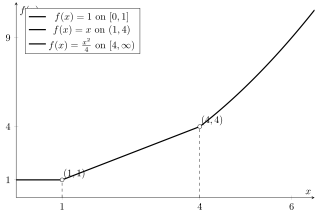
\section*{Zadanie 2.}

\subsection*{Treść zadania}
Naszkicuj wykres funkcji danej wzorem
$$
f(x) = \lim_{n \to \infty} \left(1 + \left(\frac{x}{2}\right)^{2n} + x^n\right)^{\tfrac{1}{n}}
$$
dla $x\geq0$.

\subsection*{Rozwiązanie}
Zauważmy, że
$$
\left(\frac{x}{2}\right)^{2n}=\left(\frac{x^2}{4}\right)^n.
$$
Czyli mamy:
$$
f(x) = \lim_{n \to \infty} \left(1^n + \left(\frac{x^2}{4}\right)^n + x^n\right)^{\tfrac{1}{n}}
$$
Dla dużych $n$ $n$-ty pierwiastek z sumy trzech dodatnich składników zachowuje się jak największa podstawa potęgi:
$$
f(x)=\max\!\left\{1,\;x,\;\frac{x^2}{4}\right\}.
$$

Kiedy $x > \dfrac{x^2}{4}$?
\begin{align*}
    x &> \frac{x^2}{4} \\
    x(x - 4) &< 0
\end{align*}

\begin{figure}[h!]
\centering
\begin{tikzpicture}[scale=0.9]
\begin{axis}[
    axis lines=middle,
    xmin=-2, xmax=6,
    ymin=-10, ymax=10,
    samples=200,
    domain=-2:6,
    xlabel=$x$,
    ylabel={$f(x)$},
    grid=both,
    width=\columnwidth,
    height=0.7\columnwidth,
    legend style={at={(0.98,0.98)},anchor=north east, font=\small}
]

% dodatnie obszary
\addplot[domain=-2:0, blue!60, thick] {x*(x-4)};
\addplot[domain=4:6, blue!60, thick] {x*(x-4)};

% ujemny obszar
\addplot[domain=0:4, red!70, thick] {x*(x-4)};

% miejsca zerowe
\addplot[only marks, mark=*, mark size=2pt] coordinates {(0,0) (4,0)};
\node[below left] at (axis cs:0,0) {$0$};
\node[below right] at (axis cs:4,0) {$4$};

\end{axis}
\end{tikzpicture}
\caption{Wykres funkcji $f(x)=x(x-4)$ z zaznaczeniem znaków.}
\end{figure}

Czyli z rysunku widać, że:
$$
 x > \frac{x^2}{4} \Rightarrow x\in \left(0,4\right)
$$

Rozważmy przypadki:
\begin{itemize}
  \item $0 \leq x < 1$

  Skoro $x < 1$ to
  $$
  \lim_{n \to \infty} x^n = 0
  $$
  oraz
  $$
  \lim_{n \to \infty} \left(\frac{x^2}{4}\right)^n = 0
  $$
  Zatem $f(x) = 1$.

  \item $x = 1$: $\frac{x^2}{4} = \frac{1}{4} < 1$.

  Zatem
  $$
  f(x) = \lim_{n \to \infty} \left(1^n + 1^n\right)^{1/n} = \lim_{n \to \infty} 2^{1/n}
  $$

  Znany fakcik:
  $$
  2^{1/n} = e^{\left(\ln 2\right) / n}
  $$

  Gdy $n \to \infty$ to $\dfrac{\ln 2}{n} \to 0$

  Zatem
  $$
  f(x) = \lim_{n \to \infty} 2^{1/n} = \lim_{n \to \infty} e^{\left(\ln 2\right) / n} = e^0 = 1
  $$

  \item $1 < x < 4$

  Tutaj mamy, że $x > \frac{x^2}{4}$, czyli dominujący jest $x$. Zatem
  $$
  f(x) = \lim_{n \to \infty} \left(x^n\right)^{1/n} = \lim_{n \to \infty} x
  $$
  $$
  f(x) = x
  $$

  \item $x = 4$

  Skoro $x = 4$, to $\dfrac{x^2}{4} = 4$. Mamy więc:
  $$
  f(x) = \lim_{n \to \infty} \left(2\cdot4^n\right)^{1/n} = 4\lim_{n \to \infty} 2^{1/n}
  $$
  $$
  f(x) = 4
  $$

  \item $x > 4$

  Tutaj $\dfrac{x^2}{4}$ jest dominujący, zatem:
  $$
  f(x) = \lim_{n \to \infty}\left( \left( \frac{x^2}{4}\right)^n\right)^{1/n} = \lim_{n \to \infty}\left( \frac{x^2}{4}\right)
  $$
  $$
  f(x) = \frac{x^2}{4}
  $$
\end{itemize}

Stąd
\[
f(x)=
\begin{cases}
1, & 0\le x\le1,\\[4pt]
x, & 1<x<4,\\[4pt]
\dfrac{x^2}{4}, & x\ge4.
\end{cases}
\]
Funkcja jest ciągła na $[0,\infty)$, ma załamania w punktach $x=1$ i $x=4$.

\bigskip

\subsection*{Odpowiedź}

\begin{figure}[H]
\centering
\begin{tikzpicture}
  \begin{axis}[
    axis lines=middle,
    xlabel={$x$}, ylabel={$f(x)$},
    xmin=0, xmax=6.5, ymin=0, ymax=11,
    xtick={0,1,4,6},
    ytick={0,1,4,9},
    samples=201,
    domain=0:6.5,
    width=\columnwidth,
    height=0.7\columnwidth,
    legend pos=north west,
    ]
    % przedzial [0,1] y=1
    \addplot[domain=0:1,very thick] {1};
    \addlegendentry{$f(x)=1$ on $[0,1]$}
    % przedzial (1,4) y=x
    \addplot[domain=1:4,very thick] {x};
    \addlegendentry{$f(x)=x$ on $(1,4)$}
    % przedzial [4,6.5] y=x^2/4
    \addplot[domain=4:6.5,very thick] {x^2/4};
    \addlegendentry{$f(x)=\tfrac{x^2}{4}$ on $[4,\infty)$}
    % oznaczenia punktów (ciągłość)
    \addplot[only marks,mark=*,mark options={fill=white}] coordinates {(1,1) (4,4)};
    \node at (axis cs:1,1) [anchor=south west, inner sep=1pt] {$(1,1)$};
    \node at (axis cs:4,4) [anchor=south west, inner sep=1pt] {$(4,4)$};
    % paski pionowe pomocnicze
    \addplot[dashed] coordinates {(1,0) (1,1)};
    \addplot[dashed] coordinates {(4,0) (4,4)};
  \end{axis}
\end{tikzpicture}
\caption{Wykres $f(x)$}
\end{figure}
Generated from:
./other/agh/2025/1.2.tex